South Dakota Top Blogs

News, notes, and observations from the James River Valley in northern South Dakota with special attention to reviewing the performance of the media--old and new. E-Mail to MinneKota@gmail.com

Tuesday, December 3, 2019

The age of pre-fabs and productivity

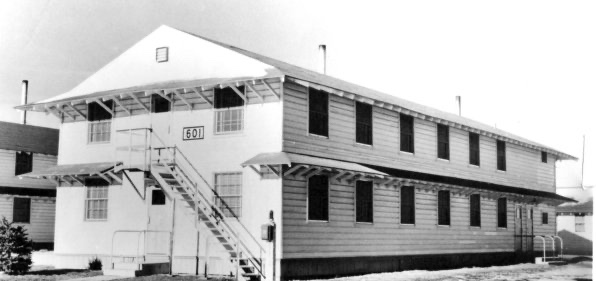
Temporary pre-fabs at Syracuse U.  They were on nearly every major campus after WW II.
In the late years of and immediately following World War II, they bloomed over the landscape like mushrooms after a spring rain.  When the G.I. Bill gave veterans the opportunity to go to college, they were used to accommodate the surge of population on campuses.  They were used for classrooms and laboratories.  They provided student housing.  As the U.S. military occupied post war Europe to help make the transition to peace time, they supplied the barracks and command offices for the U.S. forces, and in some cases the headquarters for local governments as they organized themselves.  As schools needed facilities for the children  of the baby boom, they provided school rooms for them.

The kind of barracks I lived in at Ft. Carson, Colorado. 
They were called the "pre-fabs" or "temporaries,"   buildings that could be erected very quickly to meet the need for shelter or the housing of some developing enterprise or organization.   They were the places where some of the most productive and creative times of my life took place.  The military posts I served on were filled with them.  I sweltered in one in that was used as a photo lab on a desert firing range in New Mexico where we were taking pictures of the rockets we fired off.  The post I served on in Germany had rows of them that once housed troops.  They were converted to an enlisted mens club, a movie theater, a special services club with a library and a photo lab, and they provided housing for special military projects.  We were housed in a newer 3-story billets, but the old pre-fabs were kept busy.  At one point, they were used as highly secret debriefing stations for people who escaped from East Germany.   When I left journalism to attend graduate school at the University of Iowa, the Writers Workshop was in the process of vacating its founding home in those temporary buildings to take up residence in a new English Philosophy Building. Some graduate student friends lived in them where we shared potluck dinners. And when I came to work at Northern State, there was one next to the heating plant; it housed the animal lab for the science department.
The original home of the Writers' Workshop, 1946

They came to mind when Cory Heidelberger did a post in Dakota Free Press on the utilization rate of buildings on the state university campuses.  I was struck by the circumstance of living in a time when there was often a frantic search for instructional space and now there is concern about  the low degree of use some classrooms are receiving.   The temporaries could not be called elegant, but they were functional.  When the University of Iowa was dismantling them, a professor expressed regret at seeing them replaced.

He said that they had created an environment for hard work, cooperation, and productivity.  As the faculty moved out of them into new buildings, he said that concern about status and social competition displaced the focus on work and discovery.  In the old temporaries, professors and students strived to make things work; in upgraded environs, they obsess over their competitive rankings with their fellows.  The work ethic that thrived in the modest environment of the old temporaries doesn't survive the transition to classier surroundings, the professor noted.

My experience in the pre-fabs bore out the professor's observation.   While in their unostentatious environs, my focus was on accomplishing tasks, and that usually meant engaging in cooperative work with other people.  When I became a professor,  I was dismayed at how much my colleagues were concerned about who had the most prestigious office space.  When I was assigned to an office that was larger than one occupied by a senior professor, he complained and I was ordered to exchange offices with him.  Many colleagues seemed to care little about the kind of work they accomplished in the space they occupied.  I became one of those professors who was in a campus office only during mandatory office hours when we had to be available to students.  To avoid the silly office competition,  I did most of my work at home.  

As a journalist, I covered companies that, as they became successful, moved into new and lavish quarters.  A frequent complaint was that workers became more concerned with how their status was reflected by their office space than with their work.  My status-conscious colleagues who vied for the nicest offices were doing what people do in organizations.  

A plant manager whose production facilities were moved from an old industrial area to a new "pretentious" setting said that productivity dropped when workers were put into their fancier space.  He said that in the older location, workers organized the space around them to get the work done efficiently and excellently.  When  they moved to the new, swanky building, they became more competitive about how they ranked in the company and displays of privilege and importance.  The manager said there was a noticeable change in behavior.  At the old building, they solved problems through collegial and productive dialogue.  In the new place, communication often became displays of who had the most authority, who thought they knew more, and how well connected they were with the bosses.  The effort to do productive, quality work was displaced by a quest for status. 

When the company was creating a new line of the machines that it made, the plant manager established a task force of engineers, industrial designers, manufacturing engineers, and customer service specialists to  work out the transition to the new line.  He moved the task force from the new plant building to an old house on an experimental farm where the company tested its equipment.  He said the no-nonsense work setting induced a more intensive focus and productive attitude in the task force.  While the workers had all the technological and informational resources to do their jobs, the setting was geared toward work. Status and bureaucratic politics were forgotten for a time.  

The farm house had long been converted to office and work space.  The dining room with a huge table was a conference room in which the task force gathered and consulted as it carried out its work.  Other rooms had been remodeled into offices with desks, drafting tables, computer terminals, and the like, but the work space was organized for work and communication, and not according to rank of authority and status.  When members of the task force needed to think and contemplate the work, they could go to their office space or take a stroll along the lanes of the farm.  But the space did not reflect any bases of authority or degrees of rank.  The plant manager said the task force was the most successful group he had experienced.  After the working group returned to its offices, the company used the farm house when it had special and difficult projects to get done.  The manager said the setting changed the way workers thought about their jobs and the work they did.  

I am not suggesting that companies should abandon the architectural marvels that some make their headquarters when they become successful.  But corporations cling to feudal ways in their operations.  They have royalty of various ranks who preside over the lives of vassals, the working people.  Swank environs and badges of privilege do not 
A reconstruction of Lincoln's birthplace in Kentucky.
produce good work.  

Our national history makes much of the fact that Abraham Lincoln was born in a log cabin and raised in a series of similar homes.  The story of his childhood is one of the struggle to find and develop talent in austere settings.  Lincoln lost his mother when he was nine.  She died after a time when the family moved and lived in a shelter made of logs and branches that was open to the weather on one side.  When his father remarried, he gained a stepmother who encouraged him in his reading and efforts to create a life for himself.  Lincoln resented that his father took the wages Abe earned as a farmhand and rail-splitter, but he maintained a close relationship with his parents and assisted them in building a new cabin.     Lincoln had a perspective on housing that was far from it being a status symbol:  "Let not him who is houseless pull down the house of another, but let him work diligently and build one for himself, thus by example assuring that his own shall be safe from violence when built."
The cabin Lincoln's parents built in Illinois.  

Lincoln saw houses as places that enabled life and work.  Their purpose was to support the efforts of humankind, not be the objective of those efforts:  "Labor is prior to, and independent of, capital. Capital is only the fruit of labor, and could never have existed if labor had not first existed. Labor is the superior of capital, and deserves much the higher consideration," he said.

When the plant manager moved the task force to work in the farm house, he was reasserting the primacy of work and human effort over ostentatious displays of what it can produce.  The problem he saw was that the new plant was designed to reflect the success of the company and to project an image of  superior wealth and power.  The deployment of the workers fit that pattern, and they engaged in competitive behaviors that were often geared toward personal advancement rather than work which contributed to a collective effort.   When they were in the old farm house, their concentration shifted back to the work they were to do.

In an interview of the plant manager after he retired, and he said that when his division of the company moved into a new plant the culture changed.  The company liked to show off the architecture and technology of the new building, so it had a stream of tours coming through the plant.  The workers responded as if their primary duties were to put on a show for the tourists.  Getting them to concentrate on the job of creating and manufacturing a superior product for the customers became an issue, rather than their displays of self-importance became an issue.  While the building was to portray a progressive and successful company, the people inside it weren't living up to the image.  The facilities were being used as show cases, and the show displaced the work.

That may well be why some higher education facilities are being under-utilized.  The focus is on attracting students and putting on a show of keeping up with the advances of technology, but the actual job of engaging in education that is commensurate with those advances is lagging.  And much of that kind of work could be done in a pre-fab.  Or a Lincoln log cabin.


Thursday, November 21, 2019

Longing for the days of Nixon

My congressman in office during Nixon and Watergate and I lived in the same neighborhood  as children and he was two grades ahead of me in school.  We were never close friends, but over the years we participated in neighborhood gatherings and school events, so we were well acquainted.  

He was a Republican.  Although I considered myself independent, I was registered to vote in the Republican primary, and I know I voted for him in the general election.  He was a good fit for my district in western Illinois. I lived in a factory town populated by many shop workers but surrounded by a rural area which contained some of the most fertile riverine loam in the nation.  He managed to gain the confidence of contending camps of voters and served eight terms, for two of which he was unopposed for election.

When Watergate occurred, my congressman sat on the House Judiciary Committee.  He voted for one of the articles of impeachment against Nixon.  Nixon resigned rather than face being thrown out of office.  Trump will most likely be impeached in the House on a party-line vote. Republicans in the Senate most likely will feel compelled to absolve him.  But Nixon had to face Republicans in Congress like my congressman who would not support him,  cover up for him , or excuse him in face of  the charges against him:   misuse of power, obstruction of justice, and contempt of congress.  He thought it best to resign.

My congressman served for ten years after Watergate, but his vote to impeach Nixon would catch up with him.  During redistricting, his district was redrawn to include an area of very conservative Republicans.  During the primary, the congressman drew an opponent who used the vote to impeach Nixon as a demerit against him.  He lost the primary in 1982.  The opponent lost the election.  The district has voted for a Democratic representative ever since, except for one term in which a Tea Party candidate was voted in.

During the open impeachment inquiry, not one Republican  acknowledged the charges against Trump. even though some are based upon Trump's own recorded words.  They don't want to impeach him, but neither do they have the integrity to remonstrate him for behavior which reduces the nation to a banana republic.  

There was a time when the GOP cared about the nation.  Those days are gone.

Tuesday, November 12, 2019

Trump and the art of betrayal

A recent poll reported by CNN shows that 90 percent of Republicans surveyed approve of Trump.  That means that one of our major political parties endorses and supports a proven despot and criminal.  In the most recent action, Trump was ordered to pay $2 million to charities that his Foundation  had bilked.

Among the frauds to which he admitted:  "The [Foundation] gave his campaign complete control over disbursing the $2.8 million that the foundation had raised at a fund-raiser for veterans in Iowa in January 2016, only days before the state’s presidential nominating caucuses. The fund-raiser, he acknowledged, was in fact a campaign event."  Trump's mass approval by the GOP is a signal that the United States have become the opposite of what they were intended to become.  As a Daily Beast columnist has noted, the GOP has transformed itself: “It’s still the case that too few people understand the truth about the modern GOP. It is an un-American party. It is not interested in democracy. It is interested in power. It doesn’t care how it gets it.”

The corruption and malice of Donald Trump portrays the values of a large segment of the electorate.  That segment is imposing the rule of criminality on the nation.  It is consumed by avarice and the desire for the power and openly betrays the founding principles of the nation.

The Mueller report is a detailed analysis of betrayal of the nation.  It specifies how the Trump campaign invited and often participated in a foreign government's manipulation of an American election.  And now we have a transcript of Trump openly trying to extort a foreign government into intruding into our next national election.  

The GOP has tried to divert attention away from the Mueller report and to obfuscate its findings.  The report states. "while this report does not conclude that the President committed a crime, it also does not exonerate him."

The investigation did not find a formal arrangement by the Trump campaign with the Russians, but it found an eagerness to make use of the Russian tactics:

In sum, the investigation established multiple links between Trump Campaign officials and individuals tied to the Russian government. Those links included Russian offers of assistance to the Campaign. In some instances, the Campaign was receptive to the offer, while in other instances the Campaign officials shied away. Ultimately, the investigation did not establish that the Campaign coordinated or conspired with the Russian government in its election-interference activities.

The  controlling concern was the assault on American sovereignty: "The Russian government interfered in the 2016 presidential election in sweeping and systematic fashion."

And the investigators found an active interest in the Russian activities by the campaign:


  • The presidential campaign of Donald J. Trump (“Trump Campaign” or “Campaign”) showed interest in WikiLeaks’s releases of documents and welcomed their potential to damage candidate Clinton 
  • The Russian contacts consisted of business connections, offers of assistance to the Campaign, invitations for candidate Trump and Putin to meet in person, invitations for Campaign officials and representatives of the Russian government to meet, and policy positions seeking improved U.S.-Russian relations.
Here are some instances of that active interest at work:

  • Summer 2016. Russian outreach to the Trump Campaign continued into the summer of 2016, as candidate Trump was becoming the presumptive Republican nominee for President. On June 9, 2016, for example, a Russian lawyer met with senior Trump Campaign officials Donald Trump Jr., Jared Kushner, and campaign chairman Paul Manafort to deliver what the email proposing the meeting had described as “official documents and information that would incriminate Hillary.” The materials were offered to Trump Jr. as “part of Russia and its government’s support for Mr. Trump.” The written communications setting up the meeting showed that the Campaign anticipated receiving information from Russia that could assist candidate Trump’s electoral prospects, but the Russian lawyer’s presentation did not provide such information. 
  • Separately, on August 2, 2016, Trump campaign chairman Paul Manafort met in New York City with his long-time business associate Konstantin Kilimnik, who the FBI assesses to have ties to Russian intelligence. Kilimnik requested the meeting to deliver in person a peace plan for Ukraine that Manafort acknowledged to the Special Counsel’s Office was a “backdoor” way for Russia to control part of eastern Ukraine; both men believed the plan would require candidate Trump’s assent to succeed (were he to be elected President). They also discussed the status of the Trump Campaign and Manafort’s strategy for winning Democratic votes in Midwestern states. Months before that meeting, Manafort had caused internal polling data to be shared with Kilimnik, and the sharing continued for some period of time after their August meeting. 
  • Post-2016 Election. Immediately after the November 8 election, Russian government officials and prominent Russian businessmen began trying to make inroads into the new administration. The most senior levels of the Russian government encouraged these efforts. The Russian Embassy made contact hours after the election to congratulate the President-Elect and to arrange a call with President Putin. Several Russian businessmen picked up the effort from there.
  • On January 6, 2017, members of the intelligence community briefed President-Elect Trump on a joint assessment—drafted and coordinated among the Central Intelligence Agency, FBI, andNational Security Agency—that concluded with high confidence that Russia had intervened in the election through a variety of means to assist Trump’s candidacy and harm Clinton’s. A declassified version of the assessment was publicly released that same day.While the investigation identified numerous links between individuals with ties to the Russian government and individuals associated with the Trump Campaign, the evidence was not sufficient to support criminal charges. 
  • ...the investigation established that several individuals affiliated with the Trump Campaign lied to the Office, and to Congress, about their interactions with Russian-affiliated individuals and related matters. Those lies materially impaired the investigation of Russian election interference. 
  • Further, the Office learned that some of the individuals we interviewed or whose conduct we investigated—including some associated with the Trump Campaign—deleted relevant communications or communicated during the relevant period using applications that feature encryption or that do not provide for long-term retention of data or communications records. In such cases, the Office was not able to corroborate witness statements through comparison to contemporaneous communications or fully question witnesses about statements that appeared inconsistent with other known facts.
  • Accordingly, while this report embodies factual and legal determinations that the Office believes to be accurate and complete to the greatest extent possible, given these identified gaps, the Office cannot rule out the possibility that the unavailable information would shed additional light on (or cast in a new light) the events described in the report. 
  • Among the U.S. “leaders of public opinion” targeted by the IRA (The Russian Internert Research Agency) were various members and surrogates of the Trump Campaign. In total, Trump Campaign affiliates promoted dozens of tweets, posts, and other political content created by the IRA. 
  • Posts from the IRA-controlled Twitter account @TEN_GOP were cited or retweeted bymultiple Trump Campaign officials and surrogates, including Donald J. Trump Jr., Eric Trump, Kellyanne Conway, Brad Parscale, and Michael T. Flynn. These posts included as well as allegations that Secretary Clinton had mishandled classified information.

Trump, his campaign, and his administration were fully aware of Russian efforts to intrude into American politics, and the encouraged them and made use of them.  Trump's dissembling and denials about Russian intrusion are contradicted by the hard facts.

When Trump asked the new Ukraine president to investigate Joe Biden and his son Hunter for any dirt that could be dug up or created about them, he was openly inviting a foreign nation to intervene in American elections.  He claims he had no part in Russian intrusions, but openly invites Ukraine to play such a role.  That invitation demolishes his denials about Russia.  In inviting Ukraine to  be an accomplice to his subterfuges, he betrayed the United States.  He runs the country with same vicious dishonesty that he runs his businesses.  

Trump is helped and supported by the GOP which has taken up the betrayal of the U.S. as a mission.  Freedom, equality, and justice are labeled "socialism" and must be banished rom the land.  Trump's mindless minions are being taught the art of betrayal.  And they love practicing it.  They dream of  America as The Fourth Reich.

Monday, November 4, 2019

Veterans Day: The dilemma for veterans

As Veterans Day approaches on November 11, it raises an awarenesss that being a veteran is not always easy.  Some veterans who served during times of questionable causes do not take pride in what the military did.  The Viet Nam War was opposed and regarded as a atrocity by many in the United States, and veterans returning from it were despised.  That episode was ended with the construction of the Vietnam Veterans Memorial Wall, which listed the dead soldiers and acknowledged the fact that they gave their lives honorably in service by order of their country.  Many veterans had joined the opposition to the war, but their service and sacrifice were acknowledged as honorable and patriotic.


Vietnam Veterans Memorial Wall lists 58,307 names of the soldiers killed
As a Cold War veteran, my service was not done in circumstances that called into question the moral propriety of the nature of our service.  I was a guided missile crew member in Germany with troops poised to discourage any aggressive designs that the Soviet Union had regarding our allies in Europe.  The American troops were fully indoctrinated about the rationale for our presence in Germany and were kept abreast of developments affecting it.  We were also coached about how to behave with our allies and how to set a democratic example for our adversaries.  We were there not only to provide resistance to any overt attacks, but also to earn respect for our democratic ways and try to win adversaries over to those ways.  We were constantly reminded that our role was to protect and transmit the values of liberty, equality, and justice for all. Over a long period of time, this strategy was effective with the tearing-down of the Berln Wall in1989 and the Soviet collapse in 1991.  Conventionally, it is analyzed that disaffection among those living under Soviet influence in the 1980s resulted in the collapse.  But the factors which produced the collapse are noted by scholars to have their origins in strategies that were initiated early in the history of the Cold War.  The scholars point to cultural factors that are complex and subtle.

Every night as I went to sleep in Germany, I wore headphones from my portable radio which was tuned to the Armed Forces Network.  The network played mostly music programs and was not blocked and jammed by the Soviets, as was Radio Free Europe.  As a devoted jazz fan, my bedtime show was jazz, of course.  

Years later, I met the host of the show and told him how I enjoyed and appreciated his show while in Germany. (A favorite song he played for men who were to return to their civilian lives in the U.S. was "There's a Boat Dat's Leavin' Soon for New York"  from Porgy and Bess.)  He said he appreciated his G.I. audience, but it was far outnumbered by his audience in Europe and behind the Iron Curtain.   Transmitters in West Berlin carried the signal into Soviet territory.  He said that while all forms of American music were popular to the non-American audience, jazz had a particular fascination to those living under totalitarian circumstances.  A music which originated from a people held in bondage had an underground significance to those living under repression.  It became an identifying interest for those craving a greater freedom.  It was an element that led to the collapse of the Soviet Union.  As many scholars have pointed out, the struggle of souls for freedom occurs on many fronts other than the political.  That's why jazz singer and trumpeter Louis Armstrong, and many who followed him, are recognized as some of the most effective ambassadors for America.

Veterans are facing a new dilemma with the advent of Donald Trump.  They are deeply divided on Trump.  He has some support but also a very significant opposition among veterans.  To veterans like me, Trump represents the very threat that we soldiers were defending our country against. It is not a matter of partisan politics.  It is a matter of the basic intellectual and moral premise on which America was founded and which we took an oath to preserve as soldiers.  Trump rejects that premise with a vicious malice.  He pisses on the flag.  And he is joined by supporters  whose American dream is to exercise the benefits of democracy for themselves but deny them to people they choose to hate.

It enrages me and other veterans when we are thanked for our service by someone wearing a MAGA hat. I did not serve my country to make the world safe for a bunch of neo-nazi sociopaths to rage away and destroy the progress we have made toward realizing true liberty, equality, and justice.  Trump and his dementia brigade deny those qualities as having value for the general population.  Their threat to America has forced people who understand and value the principles of our nation to see the need for an effective resistance.  That resistance may be exercised in the voting booth, but that is not enough. The Trump subversion is being spread through the media, from pulpits, and even sports arenas.  A baseball umpire announced that if Trump was removed from office, he would buy an AR-15 and start a civil war.  There are veterans out there who are willing and capable to take up the umpire's challenge.  But they also understand that the nation might not survive a major civil conflict.  Trump is forcing the nation into a division that will end in violence.  The endemic stupidity of Trump and his followers is beyond the reach of intelligence.

The country that Trump represents is not the country the armed forces have defended.  It is not the country that rid itself of slavery and pushed an agenda of civil rights.  Trump's America is what we defeated on two fronts in World War II.  It is a country in which a president can openly demean military heroes such as John McCain, Army Capt. Humayun Khan, and Lt. Col. Alexander Vindman, and a bunch of his mindless, malevolent followers will cheer him for it.  Many people take comfort in the notion that Trump and his followers are just a faction whose politics differ a bit from the democratic orthodoxy.  They are wrong.  Trump and his sycophants openly disparage and desecrate the American premises of freedom, equality, opportunity, and justice.  They blatantly defame and lie about people who do not condone their Nazi-like tactics.  They've reduced politics to the level of a juvenile playground spat replete with name-calling and malicious lies.

It is difficult to consider that I served my country so these people can spread a malignancy that threatens the nation's very existence.  But that's the irony of America.  We find what some people say to be despicable, but defend their right to say it.  And we fought wars to protect the country against the very things they practice and promote.

We live in the circumstance portrayed in  John Le Carre's Agent Running in the Field  (p. 155) just published:
"Trump might be the worst President America has ever had, I said, but he was no Hitler, much as he might wish to be, and there were plenty of good Americans who weren't going to take this lying down. 
"At first he didn't seem to hear me. 
"'Yeah, well,' he agreed in the faraway voice of a man coming round from an anaesthetic.  'There were plenty of good Germans too.  And a fat lot of bloody good they did.'"
As a veteran, I may have defended the right of Trump and his ilk to speak out.  But as a student of the resistance, I must consider the fact that if we are to keep the promise of America, taking up arms against them is not out of the question.  Veterans Day might mean turmoil in our streets.


Sunday, October 13, 2019

Turning the swamp into a cesspool


Donald Trump is desperate to win the 2020 election.  That's about the only way he can stay out of jail. The Department of Justice has decreed that a sitting president can't be indicted. When Trump is no longer sitting in the Oval Office, he could face a multitude of indictments.  


While a strong majority of  GOP voters remains stalwart in their support of Trump, and Congressional Republicans have formed a protective cadre around him, he has a few  GOP dissenters in Congress.  But he has the full-throated rejection by prominent conservative journalists, such as George Will and Bill Kristol, and the condemnation of many former GOP officials.  The media has focused on the factional disputes of the Democrats and their many candidates, but has devoted little attention to the fact that old-line Republicans are convinced that if the party is not to lose its place in the political spectrum, Trump must go.  He has put his brand on the Republican Party, and it is a brand of politics against which America has fought wars to resist.  Trump represents the antithesis of the democracy that the United States has tried to be. Recent polls indicate that a majority of Americans understand that fact.  Others don't really care what kind of government they have, only that it serves their small-mindedness and their petty hatreds.

Trump's so-called campaign rallies have become unabashed hate rallies.  At his recent rallies, he has attacked his opponents with barrages of malicious lies and accusations that defy credulity in the most casually sentient citizens.  His dishonesty and malice are an indictment of the nation that tolerates him.  Some accounts are referring to his campaign events as Klan rallies.  And some Republicans are repudiating that what he says and does has any relationship to their party.

One of his rallying cries, along with locking up Hillary Clinton and The Squad, has been "Drain the swamp."  The assumption put forward by Trump and his supporters is that all of Washington, D.C., is crooked and the offenders are their political opponents.  Trump is always claiming accomplishments that history has never before witnessed.  What history has never before witnessed is the level of corruption Trump has brought to Washington.   He has turned the city into a sepsis tank.

Any capitol city in America becomes a gathering place for hatching schemes and soliciting favors.  It depends upon people of principle and integrity to hold the grifters at bay.  Upstanding civil servants are among those who keep the government honest.  But Trump is chief among grifters.  His resume is a rap sheet.  People who support him are accomplices in the corruption.  And their first line of attack is to malign the honest and hard-working people who keep the government functioning free from the malignant infection of Trump and his followers.  That includes the press and the honest and competent civil servants.  Those who do not submit to the Trumpian plague are falsely excoriated and driven off.  

The problem for Americans now is not to drain the swamp, but to remain free from the overflow of Trump's cesspool.
Even some Republicans understand that.


Saturday, October 5, 2019

The corn picking chronicles: how farms became factories

I am so old I remember when this was how most corn was picked.  I had many uncles who were farmers in Illinois.  My dad was raised on a farm.  The farm I remember best was the one on which my maternal grandmother lived with two of her bachelor sons.  They were World War I veterans who bought a farm with veteran loan benefits.  They scrimped and struggled throughout the depression years to pay off the farm.  During World War II, the car they chauffered my grandmother around in had to have the doors held shut with baling wire. Their farm truck was a 1928 Chevrolet that they kept running.  Just before the war started, they bought a Farmall H tractor which, along with draft horses, powered them through the war.

I knew this farm because as my grandmother aged, my mother often went to help her on the farm.  I went with her, and  lived a number of summers on the farm.  In the early years, the horses were an essential part of the logistics of the farm operation.  For picking corn, they would plod along side the corn rows pulling a wagon fitted with a bang board, as pictured above, on one side.  The harvester would snap off the corn ears with a quick jerk and throw the ear into the wagon.  The toss often would be hard enough for the corn ear to hit the bang board and bounce into the wagon.  The harvesters carried corn knives which would be used to cut off ears that didn't snap off easily.   The pace of the horses would be at the speed the person picking the corn could walk along the row and snap off the ears.  The horses could be stopped and started with vocal commands, working as a team with the corn picker.
A corn husker

When a wagon was full, the horses would pull it to a corn crib with the husks still on the corn. Sometimes the corn ears were  shucked before being elevated into the cribs. Sometimes the husking was done as the corn was taken from the crib for use. The husks were removed by a corn husking machine.  Of course, at one time, the husks were removed by hand.  
A double corn crib of the kind on my uncles' farm.  Husking
and shelling was done inside.
This process was long and arduous.  Before mechanical corn pickers, the job of picking corn would last from late September through the fall into winter.  Many farmers hired help, but for many others the corn harvest was largely a family affair with children helping with the picking after school and on weekends.  Corn picking did not develop the co-operative tradition of threshing gangs that the harvest of wheat and oats and other grains did.   The husking bee at
which people ripped the husks off corn during a social occasion was one of the efforts devised to help with a tedious and time-consuming task.

The development of mechanical corn pickers is considered to have had the most dramatic impact on farming.  They provided a massive reduction in the labor needed.  But they were expensive.  During the 1930s when the transition from horse power to tractor power accelerated, farm profits were too slim to enable many farmers to buy mechanical equipment.  And some of the early mechanical pickers which could be pulled by horses or tractors were extremely awkward to operate.  Just before World War II, significant improvements were made in the engineering of corn pickers and the tractor mounted pickers (pictured above) were much easier to operate than previous designs.  However, new problems arose.  The tractor-mounted pickers had a tendency to jam and the newspapers were full of accounts of farmers getting their hands and arms caught in the pickers when trying to clear the jams.

Two of my uncles bought their farms while working as machine shop foremen at the Farmall plant in Rock Island, Ill.  So the family was familiar with International Harvester equipment.  During my freshman year in college, a high school mate started a custom harvesting business.  During the corn picking season that year, I operated an IH tractor-mounted corn picker on the night shift for him.  My uncles had taught me to shut the machine off when it jammed and to clear it with a crow bar and a knife.  My acquaintance with pickers grew, as during college, I had summer jobs at the International Harvester plant that built corn pickers and combines.  When I was released from active duty in the Army, I worked in the office of that plant for a few years.  The community where the IH plants were located was also home to the John Deere headquarters, and J.I. Case had factories there, also.  The development of agricultural equipment was the driving economic force of that community.  After I completed my college degree when I was released from military service, I got a job as farm and business editor of a local newspaper and covered farming and the farm equipment business.

However, there is a tale to tell regarding corn pickers before all that.  I had to drop out of college for a time to work. I had a job on the sports desk of a morning paper.  Because I was not attending college, I lost my deferment and got drafted into the Army.  But while I was working on the paper, a big editorial controversy came up regarding corn pickers.  When someone was injured or killed in a corn picking accident, the newspaper printed detailed stories about the accidents under the assumption that explaining how the accidents occurred was a public service that could show farmers how they could be prevented.  This produced a spate of protests from people who said we were heaping embarrassment on the people who were suffering enough from their injuries.  The paper stopped publishing the accident details.  But this produced another barrage of complaints that we weren't explaining how the accidents happened so they could be avoided.  In the end, the people who said we were adding to the woes of the wounded won out.  The editors said trying to deal with their protests was too disruptive and detrimental to the news operation, so the farm accident reports from that point on did not explain the details of what happened.  Many years later, the farm editor of that paper, who was a close associate of mine, said that decision signaled the time when the reporting of farm news became very limited in community newspapers.  He said the attitude among editors was that if someone was dumb enough to stick his hand in a corn picker, he probably didn't read newspapers anyway.

Those tractor-mounted corn pickers are things of the past.  No American companies make them that I know of, but the service parts are available to keep them running.  You can buy a new one, however, from the huge Chinese retailer Alibaba.  There is little information as to their quality.  While some smaller farmers may still use the tractor-powered pickers, most corn is harvested today with combines that can pick corn from 6 to 18 rows at a pass.  These combines run from a quarter of a million to half a million dollars a piece.   They automatically husk and shell the corn.
John Deere combines cost $380,000 to $480,000

The farm equipment business began by supplying family farmers with tools that could save labor, refine and make agriculture more productive, and eliminate some of the drudgery that made farm kids determined not to farm.  Today a small-scale farmer can't find equipment designed for his kind of operation, except for used machinery.   In the 1960s, John Deere Co. launched an advertising slogan of "The Long Green Line" to designate the history of the machinery it produced.  That history is one of producing equipment designed to help homesteaders establish their operations to the current time of building machines for huge factory-farms which are unaffordable for a family operation.    Mid-sized tractors cost between $25,000 to $50,000.  But tractors for the huge factory farms run up to $475,000.  The cost of machinery and the debt-load to pay for it during a bad crop year can put a farmer out business quickly.  That represents a change in the philosophy of farming.

My uncles who had farms were general farmers.  They rotated crops of corn, oats, hay, and sometimes specialty crops, such as barley, on their fields.  They had a herd of milk cows bred to beef bulls so that they produced both milk and beef.  They raised and fed hogs, and had a flock of chickens which supplied eggs and meat.  They usually planted a couple rows of potatoes on the edge of a corn field, and planted a vegetable garden from which they harvested and preserved enough food to last through the winter.  My bachelor uncles also had apple trees and a grape arbor.  The general farm was an extremely busy and complex operation, but it was geared to a level of self-sufficiency which enabled the farm family to survive the fluctuations of market prices and weather with which a farmer has to contend.  

In contrast, current farming is oriented to specialty agriculture,  Those who grow crops may alternate between corn and soybeans and, decreasingly, wheat.  Pork, beef, and poultry producers center their farms around confinement feeding operations.  Whereas farming was once a way to
Hogs in confinement

 achieve self-sufficiency and independence, today's agriculture is tied to corporate life.  As a consequence, farm equipment is designed to serve the corporate scale of operation, not the family-sized operation.   Tractors are available in many sizes that can be used in smaller operations, but the industry no longer makes attachments geared to support the modest operations. Economy of scale is the ruling principle that establishes the size of farms.


The corporate influence has also shaped the farm programs to push the demand for farms to get bigger.  The Environmental Working Group, which tracks farm subsidies, states:
Despite the rhetoric of "preserving the family farm," the vast majority of farmers do not benefit from federal farm subsidy programs and most of the subsidies go to the largest and most financially secure farm operations. Small commodity farmers qualify for a mere pittance, while producers of meat, fruits, and vegetables are almost completely left out of the subsidy game (i.e. they can sign up for subsidized crop insurance and often receive federal disaster payments).
Abandoned farmstead
The trend for turning agriculture into agribusiness and making rural America a huge factory system has been taking place for many decades.  It has turned once-thriving small towns into ghost communities.  The South Dakota landscape is dotted with abandoned farmsteads and deserted main streets.   A drive through the countryside is a tour of the grave markers of family enterprises that built the state.  But those remnants will eventually be removed to make way for planting as the economy of scale absorbs the land into huge factory fields.
Factory farm landscape, called intensive agriculture


Thursday, October 3, 2019

A failure of scholarship and journalism

A former colleague of mine, who is of the conservative bent, wrote a newspaper column that took up political lying and refuted the contention that universities are bastions of liberal indoctrination.  However, that was clearly not his intention.  But his column was a model of the kind of conservative propaganda that has become common in this age of Trump.  It is slovenly in its handling of facts, which would be severely criticized if the column were to be held to the standards of a professional paper.

During my many years as a professor, partisan politics was never an issue on the campuses at which I studied and worked.  Professors have political beliefs and preferences, and might on occasion let them be known, but were careful not to let them encroach on their professional duties.  They have the freedom to speak their minds in public, but did so in a way that was careful to observe their role as scholars.  For college faculty members in South Dakota, that standard is stated in the Board of Regents Policy Manual and in the collective bargaining contract with faculty:

The concept of freedom is accompanied by an equally demanding concept of responsibility. The faculty unit members are members of a learned profession. When they speak or write as citizens, they must be free from institutional censorship or discipline, but their special position in the community imposes special obligations. As learned people and as educators, they should remember that the public may judge their profession and their institution by their utterances. Hence, they should at all times be accurate, should exercise appropriate restraint, should show respect for the opinions of others, and should indicate that they are speaking only for themselves.
I did not encounter political indoctrination by professors until after I retired.  It occurred on the campus I retired from, where a coterie of "conservative" ideologues had formed and, while contending that universities were dominated by liberals, expounded their right-wing dogma.  Some students who were friends of one of my children, who attended the university for a while, told me that their cohorts were wary of this coterie, not because of their political views, but because they were presenting academic subject matter in a slanted way that made the students question the reliability of the  information they were given.

[Disclosure:  When I moved to South Dakota, I was a registered Republican, although I had never voted a straight GOP ballot.  Gov. Bill Janklow converted me to register as a Democrat.  I could not believe the things he got away with, but especially his intimidation of the press.  As someone who taught journalism, I was  perturbed at his intimidation of the press and  some of the things he said and did without full reporting and challenge by the press.]
I hold quite a different political view from my columnist colleague, but my issue with his column on political lying is with his slovenly handling of the facts.  If this column were to be presented for presentation to an organization of other historians, it would never get past the screening committee.  His column ignores the rule to "at all times be accurate, [and] exercise appropriate restraint."  The newspaper editors are also at fault because the column does not withstand a basic fact check.  

The first problem is that rather than explicitly state that his views do not represent or reflect the position of the university where he works, he pointedly states that his viewpoint is something he presents as exemplary material in his classes. He makes his identification with the university a basis for the authority he attempts to assert.  He begins with the statement that "the never-ceasing mantra of the left was that [President George W.] Bush was a liar." Then he proceeds with this paragraph:


It was curious to see pundits that had given master prevaricator Bill Clinton a pass decide all of a sudden that presidential mendacity was a big deal after all. It was curious also that the most-cited example of a Bush lie was the 43rd president’s insistence that Saddam Hussein had “weapons of mass destruction” — an idea almost the entirety of the Washington establishment (both Democratic and Republican) had at one time accepted as a gospel.
The problems are:
  1. Bill Clinton's mendacity did not get a pass nor was truthfulness a concern only with Bush.  Clinton got impeached for lying, although not removed from office.
  2. The matter of Saddam Hussein's weapons of mass destruction was investigated by the International Atomic Energy Agency whose head, Hans Blix, said it found no evidence of atomic development in Iraq.  However, Blix said that the Iraq regime had not been co-operative and suggested that the agency be allowed to inspect further and keep Iraq under international surveillance for weapon development.  George W. Bush rejected that proposal and decided to go to war.
  3. The "entirety" of the Washington establishment did not accept the premise that Iraq had weapons of mass destruction, which was the pretext for the war on Iraq.  After much debate in the U.S. House, 133 members voted against war and in the Senate 23 voted against going to war.
Then, there is this troubling paragraph:


Like an aggrieved spouse, Bush’s more unhappy critics compiled long lists of accusations. My favorite (and the one I sometimes use in my U.S. history class) catalogues more than 300 Bush lies and scandals. Included on the list: the appointment of conservative judges, the reining in of environmental and other regulatory agencies and the No Child Left Behind Act.

  1.  Here is where the professor admits that he introduces his personal bias into class as a lesson.
  2. He does not specify the source for 300 Bush lies that he derisively mentions. It is most likely David Corn's “The Lies Of George W. Bush: Mastering The Politics Of Deception” (Crown Publishers, October 2003).
  3. He lists some acts  by the Bush administration which many people opposed as if they are lies: judge appointments, nullifying some environmental regulations, and the No Child Left Behind Act.  He is not accurately representing the sources by confusing actions taken with accusations of lies.
And there is this paragraph:
Much of the push for the impeachment of President Donald Trump is similar. On the surface, we’ve got Trump’s alleged use of international connections for his own personal, political and financial advantage. But when Bill and Hillary Clinton are given a pass for the Clinton Foundation graft machine (remember Bill’s $500,000 Moscow speech?), it’s hard to believe genuine concern over corrupt foreign dealings is what’s driving Trump’s opponents.

 The problems here arise from the tendency for Trump supporters to try the "What about the Clintons?" comparisons to the misdeeds  and scandals of Trump.  

  1. Although the point of the column is the accusations of lying against Bush, the columnist evades the biggest issue of lies facing the country right now.  Trump lies so much that the press coverage of him routinely points out things he says that have no basis in fact.  In August, the Washington Post fact checker said he had surpassed the 12,000 mark for untruths he has told since he took office. Politifact also keeps a running tally of Trump's false statements.  Both fact checkers provide the sources for correct information.  
  2. Bill Clinton's Moscow speech in 2010 for $500,000 has riled the right-wing.  Between 2001 and 2012, Clinton made $104 million in speaking fees, some for more than a half million.  You can see the list and the amounts here.  Clinton's engagements were properly cleared with the U.S. government and have been investigated.  The fees largely go to the Clinton Foundation and are put to charitable use.
  3. Calling the Clinton Foundation a "graft machine" is an unproven accusation.  Graft in the political sense is a bribe to gain some kind of illicit advantage.  The Foundation has never been found to be engaged in graft. Trump's foundation, however, was closed down by the State of New York for its nefarious activities.
  4. With the nation so suffused with lies coming out of Trump's White House, it is absurd to bring up the subject of political lies without acknowledging Trump's habitual falsehoods.
There are other points in the column that are the echolalia of Trump.  When Adam Schiff, summarized Trump's telephone call with the new president of Ukraine Zelensky in sarcastic and parodic terms, Trump was too illiterate to discern it as ridicule and termed it a malicious misrepresentation of what he said.  The professor repeated Trump's ignorant, possibly purposeful, mischaracterization of Schiff's critical lampoon.  As the saying goes, “Sarcasm – the ability to insult idiots without them realizing it.” 

The issue here is not that a professor spoke out as a citizen, but that he allowed his partisan passions to overrule the critical skills that professors and journalists are expected to apply to information they pass on to others.  The result was a failure to observe the mandate to be accurate, restrained, and respectful.  It is a failure that tarnishes the profession and his institution.  And the newspaper that published it.

. 


Blog Archive

About Me

My photo
Aberdeen, South Dakota, United States

NVBBETA